





Hohm sweet Hohm

Take a sneak peak at Microsoft Hohm, a free online app that helps users rein in household energy use.
Not satisfied with rearranging Netflix queues, managing checking accounts, placing items in virtual shopping carts, updating your Facebook status and Tweeting your brains out? A new free online application from Microsoft lets you spend time micromanaging your home energy consumption as well.

According to CNET, next week Microsoft will launch Hohm, an app designed to help folks save money (and the environment) by providing them with an online platform where they can monitor natural gas and electricity usage. Hohm is Microsoft’s contribution to the IT home-energy-monitoring craze, joining the ranks of similar free web-based apps like Google PowerMeter. Personally, I’m not sure if I need another thing on the internets to obsess over (Keyboard Cat’s got me covered) or fiddle with (thank you, FB), but I love the idea behind this.

Here’s the thing: when it comes to household energy conservation, knowledge is everything. But it seems that people generally don’t know what the heck is going on … a couple of bills arrive every month and we groan when they increase but we pay them and move on. All and all, it’s a vague and unpleasant affair. Applications like Hohm that allow users to see tangible proof of how energy is being misused and be told specifically what they can do to curb it have the potential to be big.

Although Hohm is in the beta stages and it sounds like utility providers don’t yet have the ability to feed information into the program (meaning users have to enter energy profiles manually), ideally the program will not only let you view and monitor your home energy use but also compare trends, interact with an online community, and get tailored recommendations on how to conserve energy using analytics from the Department of Energy and Lawrence Berkeley National Laboratory.

Would you regularly (ie: obsessively) use an online app like Hohm to rein in energy use, move forward with home improvements, and save a few bucks?  Or would a more direct approach, like an unexpected visit from an energy surveillance firm, be more effective? Or do you even want to know the dirty details of your utility bills? Is ignorance bliss in this case?

Matt Hickman is the eco-living blogger for the Mother Nature Network, where this article was originally published.

Boy discovers microbe that eats plastic

PhDs have been searching for a solution to the plastic waste problem, and this 16-year-old finds the answer.

plastic-bags-landfill It’s not your average science fair when the 16-year-old winner manages to solve a global waste crisis. But such was the case at last month’s May’s Canadian Science Fair in Waterloo, Ontario, where Daniel Burd, a high school student at Waterloo Collegiate Institute, presented his research on microorganisms that can rapidly biodegrade plastic.

NOTE: there are TWO high school students who discovered plastic-consuming microorganisms. The first was Daniel Burd (last year). The second was Tseng I-Ching (last month), a high school student in Taiwan.

Daniel had a thought it seems even the most esteemed PhDs hadn’t considered. Plastic, one of the most indestructible of manufactured materials, does in fact eventually decompose. It takes 1,000 years but decompose it does, which means there must be microorganisms out there to do the decomposing.

Could those microorganisms be bred to do the job faster?

That was Daniel’s question which he put to the test by a very simple and clever process of immersing ground plastic in a yeast solution that encourages microbial growth, and then isolating the most productive organisms.

The preliminary results were encouraging, so he kept at it, selecting out the most effective strains and interbreeding them. After several weeks of tweaking and optimizing temperatures Burd was achieved a 43 % degradation of plastic in six weeks, an almost inconceivable accomplishment.

With 500 billion plastic bags manufactured each year and a Pacific Ocean Garbage Patch that grows more expansive by the day, a low cost and nontoxic method for degrading plastic is the stuff of environmentalists’ dreams and, I would hazard a guess, a pretty good start-up company as well.

NOTE: to the comment below. Yes there are certainly methods for decomposing plastic, but most are chemical in nature not organic, requiring high temperatures and chemical additives to cause the plasticizers to vaporize, for instance this patent on PVC extraction. There have been several successful bacteria based solutions developed at the Dept. of Biotechnology in Tottori, Japan as well as the Dept. of Microbiology at the National University of Ireland, but both apply only to styrene compounds.

It goes without saying that these discoveries need to be tested to ensure, for instance, that the bi-products of organic decomposition are not carcinogenic (as in the case with mammalian metabolism of styrene and benzene). The processing of plastics by these methods would also have to be contained in highly controlled environments. So, no, we’re not talking about a magic panacea or a plastic-free paradise, but the innovative application of microorganisms to break down our most troublesome waste products is nevertheless a major scientific breakthrough.

ANOTHER NOTE: one of our readers pointed out a very interesting study in 2004 at the University of Wisconsin that isolated a fungus capable of biodegrading phenol-formaldehyde polymers previously thought to be non-biodegradable. Phenol polymers are produced at an annual rate of 2.2 million metric tons per year in the United States for many industrial and commercial applications including durable plastics.

Don’t do RSS? Follow all Karl Burkart posts and tweets @greendig or on Facebook.

Karl Burkart is the technology blogger for the Mother Nature Network, where this article was originally published.

Voices of the ReGeneration: Phaedra Ellis-Lamkins, CEO of Green for All

Phaedra Ellis-Lamkins lo-res Since its inception in 2008, Green For All has had considerable success in lifting public awareness on the potential of green-collar jobs to transform the economy, curb global warming, and build pathways out of poverty for our most vulnerable communities.  Their case is simple: Green For All believes a shift to a clean-energy economy can improve the health and well-being of low-income people, who suffer disproportionately from cancer, asthma and other respiratory ailments in the current pollution-based economy.  And such a shift can also create and expand entrepreneurial, wealth-building opportunities for American workers who need new avenues of economic advance.

The past President of Green For All, Van Jones, was so successful at garnering attention for the organization that he was appointed Special Advisor for Green Jobs, Enterprise and Innovation at the White House Council on Environmental Quality.  (My ReGeneration Road Trip travel partner, Sarah van Schagen of Grist.org, had the opportunity to interview Mr. Jones during our time in Oakland, CA).  His successor, Phaedra Ellis-Lamkins, shares Van Jones’ passion and charisma, and has extensive experience working in these communities.  Prior to joining Green For All, Phaedra was head of the South Bay AFL-CIO Labor Council and Working Partnerships USA. While there, she earned her reputation as one of the nation’s most brilliant, inspirational and creative problem solvers for working families.  She played a key role in expanding the living wage and launching the Partnership for Working Families, among other achievements.  She is clearly perfectly suited to fill the big shoes left by her predecessor, and shape Green For All into a leading organization within the environmental and labor movement. 

We recently had the chance to ask Ms. Ellis-Lamkins a few questions about Green For All, her role in the organization, and what is next for the movement.  We naturally jumped at the opportunity.

How would you describe your view of what’s going on in the environmental movement and what do you see as the core problem-solution?

Green Jobs Now - Oakland This is a very exciting time in the movement for a clean energy economy.  A year ago, we were inspiring people with a new idea:   that we can fix the economy and the environment at the same time by creating living wage jobs that are good for the planet.

Today, we are moving from inspiration into implementation.  We are turning that idea into reality and were given an excellent kickstart with President Obama’s recovery package, which invests billions in the clean energy economy.  Cities and states across the country are creating new models of green business that will show the way to a cleaner, safer, healthier future for everybody.  And Green For All will be there every step of the way ensuring that best programs and policies are implemented, which create real jobs for real people.

What’s your background that has led you to this cause? You were very successful in healthcare reform and helped to raise minimum wage for low income families, so what was the catalyst for deciding to make that move?

I see joining Green For All as a continuation of the work I did with the labor movement.  All of that work had the same goal: to help people build a better life for themselves and their families.

That’s what we do at Green For All.  The clean energy economy is the best chance we have to create dignified jobs for working families and pathways out of poverty for millions of Americans.  We can create clean, safe and healthy communities for the people who have struggled the most under the old, pollution-based economy.

What’s the perception of environmentalism in the African American community? Is it still a “for other people” mentality?

I think the African-American perspective is, in a lot of ways, similar to anyone else’s perspective.  Most people, first and foremost, want to make sure their families are healthy, happy and safe.  In communities that struggle with joblessness, pollution, lack of health services and healthy food for their children, above-average crime and violence, or any of the other challenges common in low-income communities and communities of color, dealing with those problems comes first.

That’s what is so beautiful about the clean energy economy.  It has the potential to solve those immediate, bread-and-butter problems AND heal the planet from the pollution and poison of the last 250 years — at the same time.

When we can make what’s good for families right now also good for the planet now and in the future, EVERY community will get behind it.  And that’s what clean energy jobs do.

What are you doing to make the green movement more accessible?

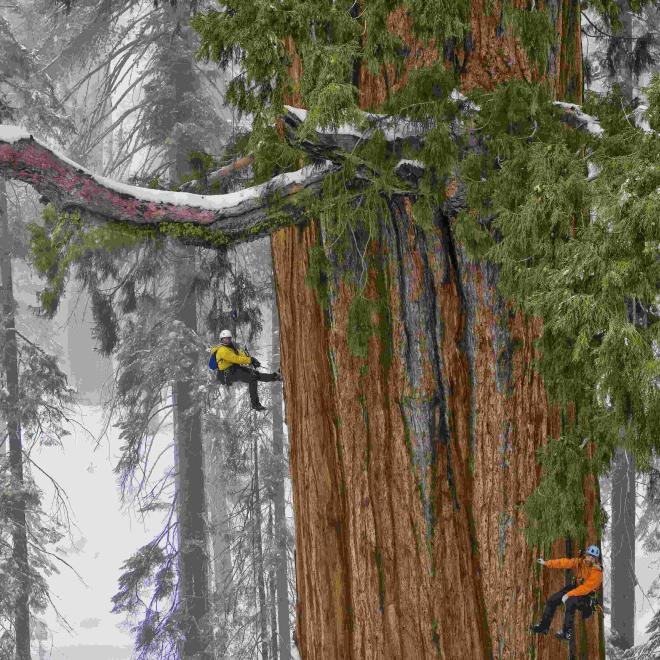
BEST Trainee Mitchell Battle demonstrating his tree climbing prowess Everything we do is aimed at making sure not only that we build a clean energy economy, but that everyone has a chance to succeed.  That starts with making sure that those who are so often left out and left behind — low-income people, working people, people of color, women, young people — have a voice and a presence in this movement and in the national debate.  From our Green For All Academy, to the technical assistance we offer local leaders, to the alliances we help forge at the local, state and national level throughout the country — we always make sure that disadvantaged communities have the space to participate and to lead.

But a place in the movement — in the debate — is not enough.  These communities also need a fair share of what this movement is creating, starting with clean energy jobs.  That’s why the policies and programs we help design and implement always aim to create jobs for those who need them most — the unemployed, the underemployed, and those with barriers to employment.

The chance to renew our national commitment to the highest American ideals — equality, fairness, opportunity for all — is the special promise of the clean energy economy.  We cannot afford to let that chance pass us by.

What do you see as the biggest hurdle for Green for All’s mission in the environmental movement?

The biggest hurdle in our mission is the second half of our name: “for all”.  At this point, we have a lot more momentum towards building a green economy than we do towards making sure that economy works for every community.  Inspired by groups like Green For All, 1Sky, the Apollo Alliance and more, President Obama has included the biggest investment in the clean energy economy ever in his recovery package.  Now we must work to make sure that low-income people, people of color and women will have a chance to earn the jobs that those investments will create.  We must make sure that every community gets to enjoy the benefits of this new clean energy economy. 

What is next for Green for All, and what can people do to help out?

Green Jobs Now - Windmills Over the past few months we’ve been supporting local leaders across the country who are working to make sure that the billions in President Obama’s recovery package translate into green jobs for everyday people.  These leaders are doing amazing work to ensure community involvement, transparency, and job quality in the recovery implementation.  They want to make sure that these clean energy investments create pathways out of poverty.

We are also focused on the American Clean Energy and Security Act of 2009, the bill tackling our formidable energy and climate challenges.  We have two main goals.  First, we want the bill to invest more in America’s workforce and communities with job training, specifically with funds for the Green Jobs Act of 2007.  Second, we want the bill to include targeted hiring provisions that ensure that local workers and low-income workers get the chance to earn and keep the jobs that the bill creates.

The easiest way for people to get involved is by telling Congress you support these improvements to the American Clean Energy and Security Act.  It’s easy.  Just go here.

Previous Stories

Archive: June   May   April   March   February   January   December   November   October   

Thanks for sharing what green means to you!

If you'd like others to see your message, please join The ReGeneration it's quick, easy and your input makes a difference.

Cancel

Please take a moment to tell us about yourself.

What are your top environmental concerns?

What are you already doing to make a difference?

Skip these questions

Congratulations! You have joined The ReGeneration.

Logo

Close

Joining Up...

Loader